Forts
Gurudwara Qila Anandgarh Sahib
Qila Anandgarh (Fort of Bliss) is situated in the middle of the town of Anandpur Sahib.
During the 1930’s, Kartar Singh Kalas Alia built a new Qila which is still intact on top of the hillock.
It is a newly constructed building though marks of the old, original structure are also still traceable. It was the strongest of the five forts.
The present Gurdwara, separated from this building by a spacious terrace paved with slabs of streaked marble, is a 15-metre square hall with an 8×3 metre porch in front.
The present Gurdwara building complex was raised during the 1970’s by Seva Singh whose successors are now managing and further developing it. Under the Gurdwara Sahib there is also a sacred Baoli Sahib. It is situated in the south east side of Takht Sri Keshgarh Sahib.
The 6-metre square sanctum within the hall has above it a lotus dome topped with a gilded pinnacle and khanda. The entire wall surface has a facing of streaked marble. This building was completed in 1970. The water level of an old baoli, a stepped well 4-metre in diameter, is approached through a covered passage.
The baoli has 135 marbled steps. At the lower levels on the eastern flank of the main building are a spacious hall for Guru ka Langar constructed in 1972, and 300 rooms for pilgrims and administrators.

Gurdwara Qila Holgarh Sahib
Qila Agamgarh or Holgarh (Fort of Colour) was the Qila where Guru Gobind Singh introduced in the spring of 1701, the celebration of Hola Mahala on the day following the hindu festival of colour, Holi.
In order to keep Sikhs away from the fake and meaningless rituals of the hindus in which they would throw colour and water, Guru Sahib used to organize competitions of wrestling, sword wielding, arrowshooting, skills at arms in simulated battles, etc.
The fort is about one and a half km north-west of the town across the Charan Ganga rivulet. It was the third strongest fort built by Guru Gobind Singh Ji.
Hola or Hola Mahalla, thereafter became an annual event of warlike sports in Anandpur Sahib as long as the Guru stayed there. The observance of Hola Mahalla was revived after the Sikhs had established their rule in Punjab. It is now the biggest festival of Anandpur.
The mahalla or the march on this occasion starts from the Takht Sahib on the concluding day of the week-long festival and ends at Holgarh, where sports like fencing, coil-throwing and tent-pegging are held.
The present building, a three-storeyed octagonal, domed edifice, was constructed under the supervision of Sant Seva Singh and was completed in 1970. The sanctum is in the middle of the marbled ground floor.

Gurudwara Qila Taragarh Sahib
Qila Taragarh (Fort of Stars) is situated on the outskirts of Anandpur Sahib. It is located 5km from Anandpur Sahib and was built to stop the advancing hill armies before they arrived in Anandpur. Qila Taragarh was built on the top of a hill where one could see for miles around.
There was also a baoli (open well with steps leading down to water level) dug to ensure supply of water for the garrison.

Gurudwara Qila Fatehgarh Sahib
When Qila Fatehgarh (Fort of Victory) was being constructed, Sahibzada Fateh Singh Ji was born hence it was named in his honor.
The Gurdwara is a two-storeyed domed building. In front of it is an old well which once served the needs of Fatehgarh Fort.
The present building was constructed during the late 1980’s under the supervision of the successors of Seva Singh.

Gurudwara Qila Lohgarh Sahib
Qila Lohgarh (Fort of iron) is situated in the southern side of Anandpur Sahib in Ropar Distt. and was the second strongest Qila after Qila Anandgarh sahib.
Guru Sahib had set up a factory for manufacturing of arms. The hill armies attacked city Anandpur Sahib many times but were defeated by the Sikhs from this Qila, as its gate could not be broken.
It is situated at one and a half kilometre southwest of Takht Sri Keshgarh Sahib. The fort was constructed by Guru Gobind Singh to protect the river flank of Anandpur. It was here that Bhai Bachchittar Singh faced and turned back a drunken elephant which the hill chiefs, during their siege of Anandpur in 1700, had sent to batter down the gate of this fort.
Bhai uday singh chopped the head of Raja Kesari Chand on the same day here. Only after sikhs evacuated this city in December 1705, hill armies occupied this Qila and demolshed it.
The present building, octagonal in shape and three-storeyed high with a dome on top, was constructed during the late 1980’s.
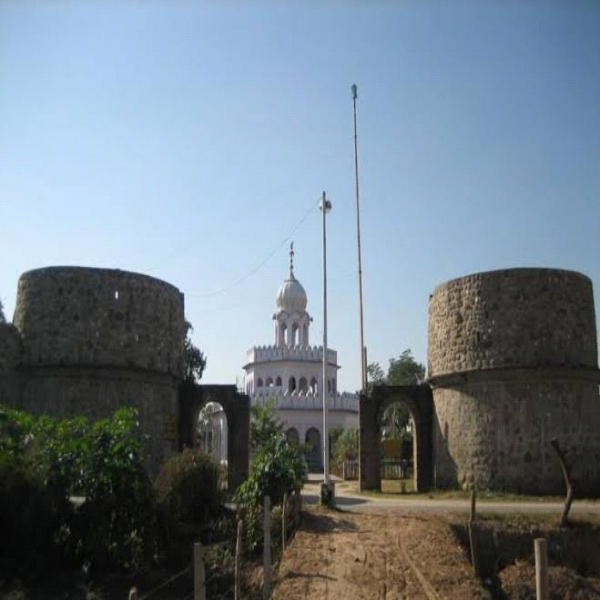
Kila Haveli
The history of Kila Haveli at Anandpur Sahib is deeply rooted in the Mughal period style architecture, standing impressively tall for over 350 years. Built during the Sikh era in the mid-16th century, it is considered a rare example of Sikh architecture, preserving its original ornamentation.
Originally the residence of Baba Surajmal Ji, son of Guru Hargobind Sahib Ji, the haveli played a significant role in Sikh history. Known as Kila Haveli Wadi Sarkar, it served as the ancestral home for generations, witnessing pivotal events in the Sikh faith.
Situated amidst Gurudwara Sis Ganj Sahib and Gurudwara Kesgarh Sahib, the haveli has been a seat of important decision-making, from the Sikh guru era to the British Raj. It housed areas like Diwan-i-Khas and Diwan-i-Am, where the head of the Sodhi clan presided over meetings.
The haveli, with its ancestral family kitchen and langar service, holds historical significance, hosting dignitaries from Maharaja Ranjit Singh to British Raj officials. Its architectural grandeur, standing at 52ft with nanakshahi bricks, reflects the period around 1655.
Preserving its originality during the Khasla Tricentenary Celebration in 1999, the Killa Haveli stands as the sole existing structure from that era in Anandpur Sahib. It also played a role in a key historical event related to Guru Tegh Bahadur Ji.
The ongoing effort to recreate, restore, and conserve this majestic haveli aims to ensure that future generations of the Sikh faith can witness and appreciate this slice of history, testifying to a glorious heritage.
